The oldest forests on the continent do not give up their contents easily.
The Pacific Northwest encompasses the largest temperate rainforest in North America, a coastline of 4,000 miles of fog and open water, and mountain ranges that remain genuinely unmapped in their interior reaches. The Cascades, the Olympics, the Coast Range — these are not wilderness areas in the managed sense. They are the kind of terrain that absorbs things and does not return them.
What is documented here spans two distinct ecological zones: the land and the water. The old-growth forest interior of the Cascades and Olympic Peninsula produces the highest density of large hominid sightings on record, with track casts, auditory recordings, and thousands of independent witness accounts accrued over 150 years. The coastal waters and estuaries — Puget Sound, the Salish Sea, the Columbia River estuary — produce a separate, parallel archive of serpentine aquatic entities with their own continuous tradition, dating to before European contact.
Coast Salish peoples have named and described these entities for as long as their oral tradition extends. The European settlers who arrived in the 19th century did not bring these accounts with them. They found them here. The creatures were already named. The places they inhabited were already marked. That is not how folklore works. That is how field records accumulate.
Documented Entities
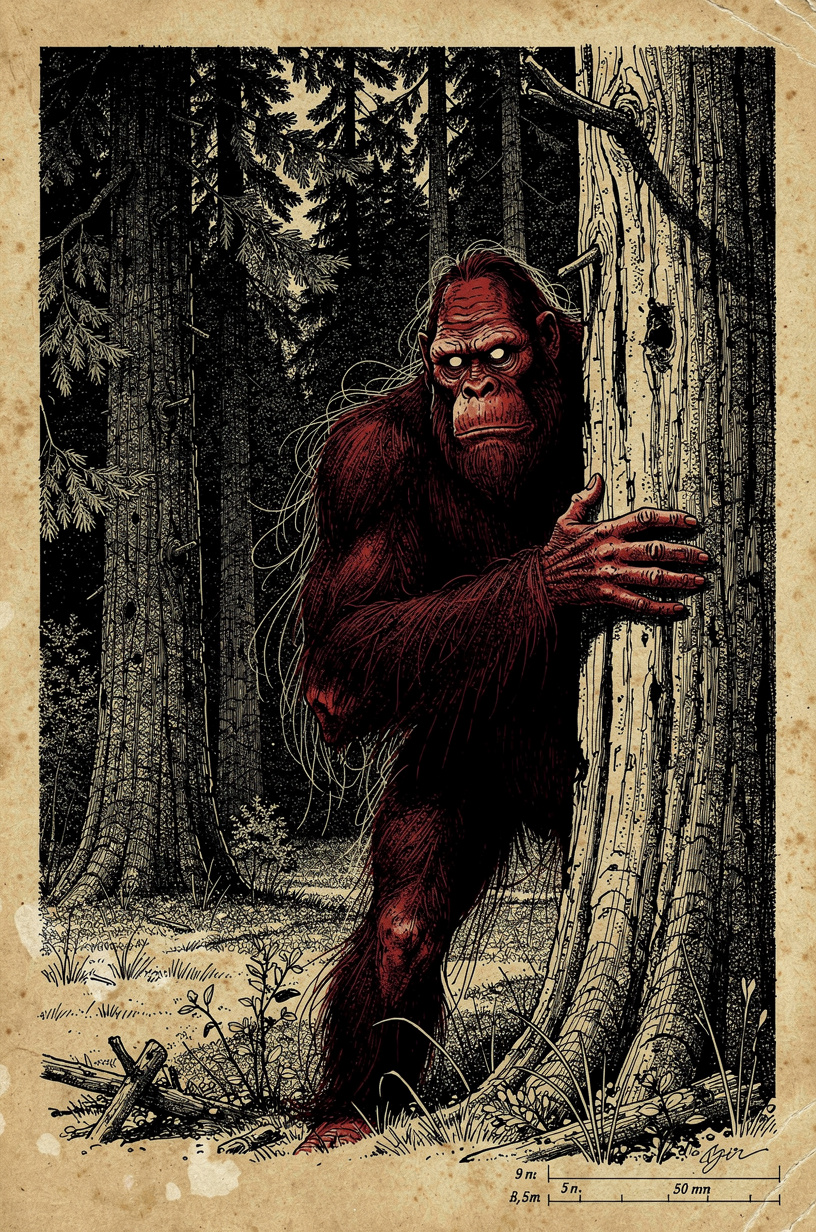
Sasquatch
The oldest name for what moves through old-growth forest at dusk.
Sasquatch is the most extensively documented cryptid in North America and the anchor around which all Pacific Northwest anomalous encounter research orbits. The physical profile is unusually consistent across thousands of independent accounts spanning 180 years: a bipedal hominid, 7–10 feet in height, massively built, covered in dark brown to reddish-brown fur, with arms proportionally longer than human norms and a pronounced sagittal crest on the skull. It moves with a fluid, ground-covering stride. It smells. It watches.
The Halq'eméylem-speaking peoples of the Fraser Valley have recorded the entity under the name "Sésquac" — meaning "wild man" — for as far back as their oral tradition extends, with specific geographic territories assigned to it. The Lummi and Nooksack peoples call it "Ts'emekwes." These are not ghost stories. They describe a biological entity that shares terrain with human communities and must be navigated accordingly — something with behavior patterns, seasonal movements, and specific areas it controls.
The 1967 Patterson-Gimlin film — shot at Bluff Creek in northern California, the southern edge of the Pacific Northwest range — remains the most studied piece of potential evidence in cryptozoological history. Over fifty years of forensic analysis, gait analysis, and primate anatomy review has produced no consensus that the footage is fabricated, and several consensus opinions that the movement depicted is not achievable in a costume given the technology of 1967. It has not been definitively proven authentic. It has not been disproven.
"The smell hit us first. Like wet fur and something rotten underneath it. Then the knocking started — three heavy impacts on a tree, maybe 200 yards east. We stopped moving. I put my hand on my dog. He wouldn't make a sound. Then, from a completely different direction — maybe 400 yards west — three knocks answered it. Same cadence. Deliberate. And then both of them went silent at exactly the same moment, and that silence was worse than either sound."— BFRO Report #52241; two-witness account, guide and client, verified by investigator
The Cascade foothills east of Seattle — particularly the areas around Mount Rainier, Gifford Pinchot National Forest, and the Snoqualmie Pass corridor — produce the highest density of contemporary reports. The Olympic Peninsula has a separate sighting cluster associated with the old-growth lowland rainforest. Both areas share a characteristic: the forest is old enough and continuous enough that something very large could theoretically move through it without ever needing to cross open terrain.
- Gifford Pinchot NF, WAHighest report density in PNW
- Olympic Peninsula, WAOld-growth rainforest cluster
- Snoqualmie Pass corridor, WAActive seasonally
- Mt. Hood National Forest, OROngoing reports
- Fraser Valley, BCHistorical and current sightings
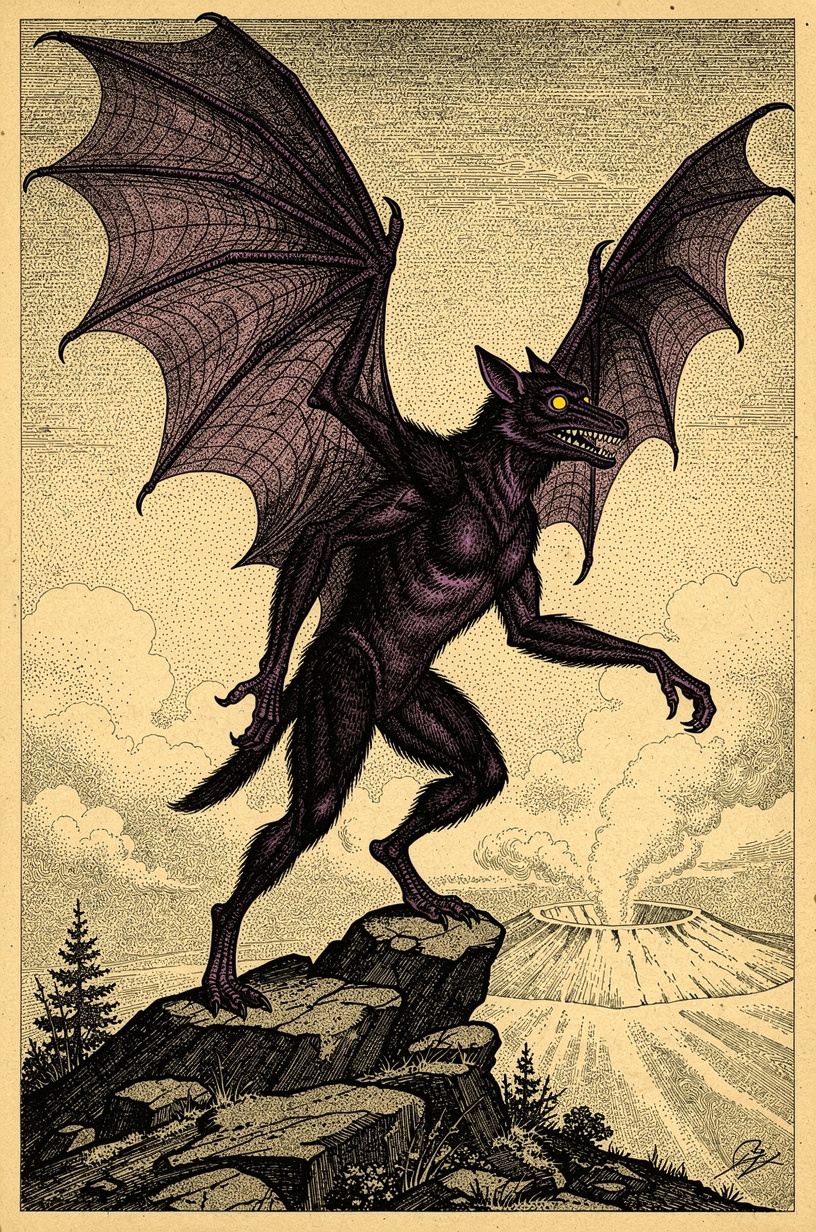
Batsquatch
Seen above Mount St. Helens. Twenty feet of wingspan. No photograph survived.
The first documented Batsquatch encounter occurred on the night of April 7, 1994, when Brian Canfield was driving near Buckley, Washington — a small logging community on the southeast flank of Mount Rainier, approximately 40 miles from Mount St. Helens. His truck engine died without warning. Standing in the road ahead of him was a creature approximately 9 feet tall, covered in dark purple-tinged fur, with bat-like wings folded against its body, a lupine face, and eyes that caught his headlights in a yellow glow. The entity observed him for a period he estimated at thirty seconds, then spread its wings — a span he estimated at 20 feet — and was airborne in a single movement, climbing at a rate that suggested musculature of extraordinary development.
Canfield's engine started again once the creature was gone. He did not return to that road for three years. His account was filed with the Mutual UFO Network and independently investigated. No explanation was offered.
A second account from the same general area followed within weeks, filed by a different witness who had not heard of Canfield's encounter. The physical description matched on the key distinguishing features: the wingspan, the purple-tinged fur, the yellow eyes, and the vertical takeoff. Researchers note that both encounters occurred within the blast zone of Mount St. Helens' 1980 eruption — a region that experienced radical ecological disruption and that remains, in its deep interior, largely unmonitored.
"Whatever disturbed 150 square miles of old-growth forest in 1980 also disturbed whatever lived in it. We don't know what the pre-eruption fauna inventory was for the deep backcountry. We never surveyed it. If something was displaced from the interior blast zone, we would have no baseline to compare it against. The absence of a prior record is not evidence of absence."— Cascadia Anomalous Research Association, internal field notes, 2002
- Buckley, WAInitial 1994 encounter — engine failure
- Mt. St. Helens blast zonePost-eruption habitat disruption
- Cascade SE foothillsSubsequent unconfirmed reports
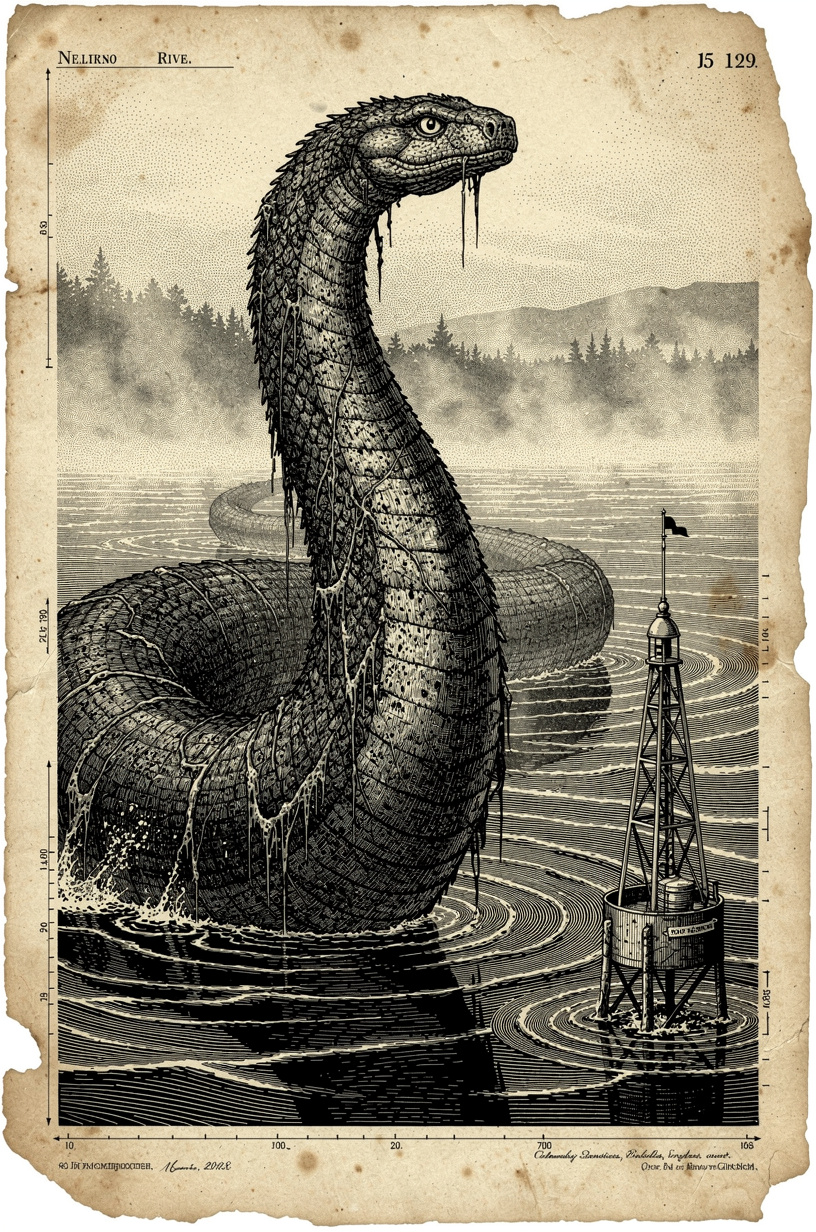
Colossal Claude
A serpentine bulk reported in the Columbia River estuary since 1934.
In 1934, the crew of the fishing tender Viv reported an encounter in the Columbia River estuary near the Oregon-Washington border that introduced the Pacific Coast's second major sea entity into the written record. The creature was described as approximately 40 feet in length, serpentine in body, with a rough shaggy exterior — "like a hairy cow," in the words of first mate George Wetherby — a long neck, and a small blunt head that it raised several feet above the water to regard the vessel. The encounter lasted several minutes before the entity submerged.
Additional sightings followed: a fisherman off the Oregon coast in 1935, a crew of the lightship crew anchored at Heceta Head in 1937, and multiple accounts along the Astoria waterfront through the early 1950s. The name "Colossal Claude" was applied by newspapers during the 1930s coverage; it stuck. Several researchers have proposed that Claude represents the same species documented further north as Cadborosaurus, operating at the southern edge of the entity's range.
What distinguishes the Claude accounts from simple misidentification reports is the consistency of the "hairy" or "rough-textured" surface description across independent witnesses who could not have read each other's accounts. This distinguishes it from known pinnipeds and cetaceans, which do not present a shaggy exterior. The estuary and Columbia River bar — one of the most dangerous waterways in the world — are not heavily surveyed, and the depth and turbidity of the water at the river mouth would permit a large animal to inhabit the zone with minimal surface exposure.
"It had a large, hairy body, a big head, a long neck, and a huge, long body — something like a camel in shape, with the neck carrying clear of the water. It was watching the boat. It wasn't afraid of us. After it looked at us for a while it went under. Smooth, like it knew exactly how."— First Mate George Wetherby, tender Viv, Columbia River estuary, 1934; as reported in the Oregon Journal
- Columbia River bar, OR/WA1934 — initial account, tender Viv
- Heceta Head, OR1937 — lightship crew, multiple witnesses
- Astoria waterfront, OR1940s–50s — intermittent
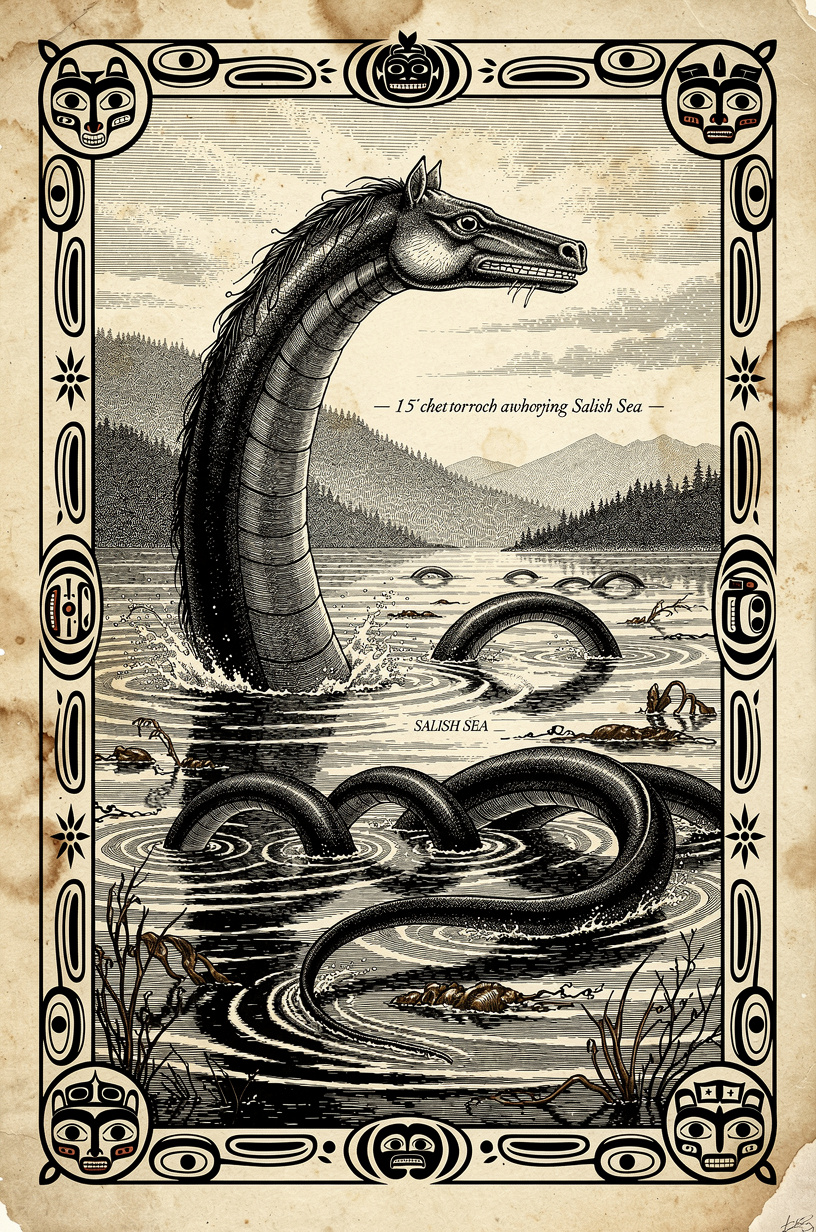
Cadborosaurus
The sea serpent of the Salish Sea. Indigenous testimony predates European contact.
Cadborosaurus — known colloquially as "Caddy" since the 1930s, named for Cadboro Bay near Victoria, British Columbia — holds the distinction of being the most documented sea cryptid on the Pacific coast of North America, with a continuous witness record extending from the present day back to pre-contact Indigenous tradition. The physical profile is specific and consistent: a long serpentine body, a neck that extends 10–20 feet above the water surface, and a head described variously as horse-like, camel-like, or ovine — with small protuberances resembling ears or short horns. Vertical undulation of the body when moving, rather than the horizontal undulation of known serpents, suggests a vertebrate structure.
The Manhousat people of western Vancouver Island call the entity "Hiyitl'iik." The Comox and Pentlatch peoples had related names. The Kwakwaka'wakw tradition includes the being within the cosmology of Komokwa, the Undersea Chief — a position suggesting significant cultural weight, not casual observation. When Victoria's Times Colonist published the first European documented sighting in October 1933, it was not a discovery. It was a transcription of knowledge that had existed in the same waters for centuries.
The most remarkable physical evidence comes from 1937: a carcass recovered from the stomach of a sperm whale harpooned off the Queen Charlotte Islands. The remains — photographed before decomposition — showed an elongated creature with a long neck and a distinctly horse-like head, approximately 10 feet in length and appearing juvenile. The photographs were forwarded to the Provincial Museum of Natural History and have been analyzed repeatedly without a definitive taxonomic identification being made.
"It came up approximately 40 yards off the port bow. The neck was out of the water — easily fifteen feet of it, maybe more — and the head was turning, almost casually, like it was looking at something on the shore. The skin was dark, glistening. It was not a whale. It was not a sea lion. It was not anything I've ever seen in thirty years of working these waters, and I have seen everything that is supposed to be in these waters."— Filed via BC Anomalous Sightings Archive; tugboat captain, 30-year veteran of Saanich Inlet operations
- Cadboro Bay, Victoria, BCNamesake location; ongoing
- Saanich Inlet, BCMultiple independent accounts
- Strait of Georgia, BC/WAHistorical and modern sightings
- Queen Charlotte Islands, BC1937 carcass recovery location
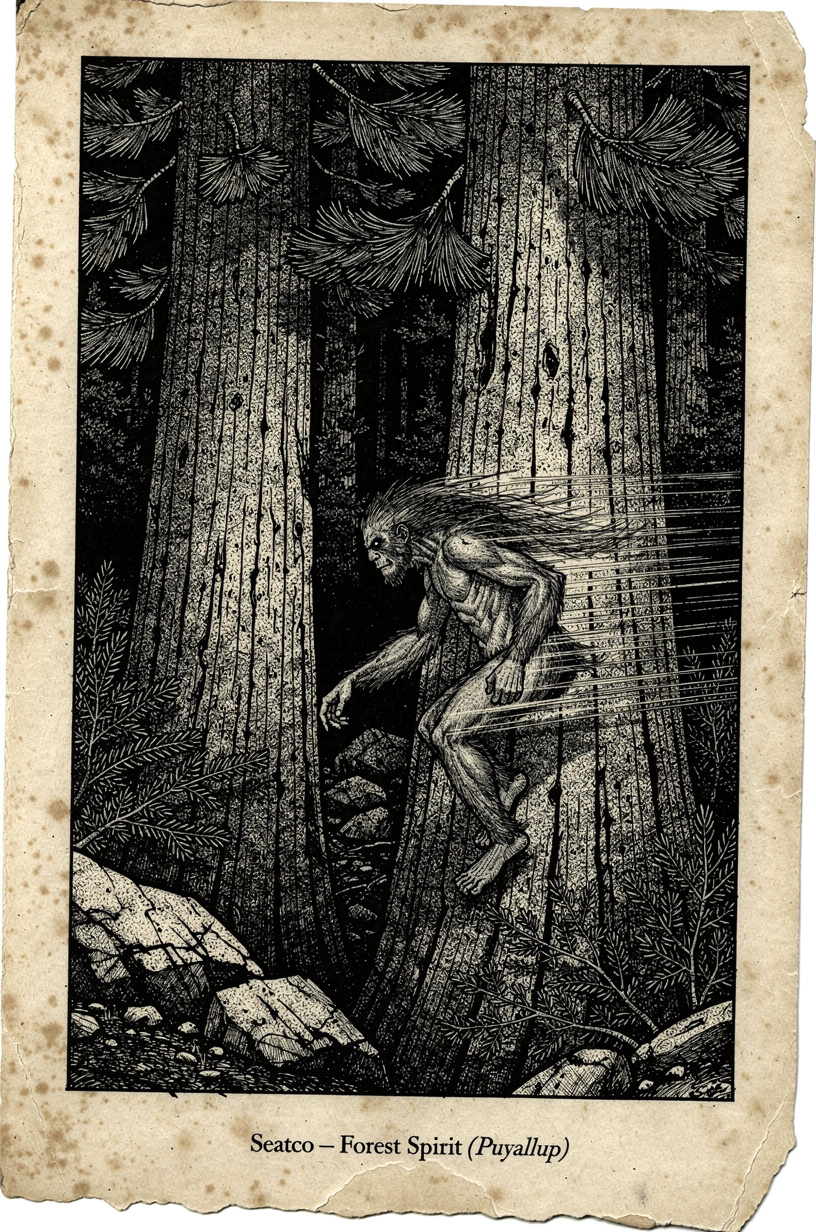
The Seatco
The Puyallup name for the forest spirits that hold the mountain passes.
The Seatco — recorded in Puyallup and Nisqually tradition, with related names and concepts among the Lushootseed-speaking peoples of the Puget Sound basin and the interior Plateau tribes — is explicitly not Sasquatch. Researchers who conflate the two entities are told so, consistently, by the peoples whose tradition includes both. The Seatco is older, faster, and more dangerous in its intent. Where Sasquatch is powerful and territorial but not consistently predatory, the Seatco is described as purposefully malevolent — a being that takes people. The Puyallup tradition includes specific warnings about mountain passes that should not be traveled alone after dark, with the Seatco named as the reason.
Physical descriptions, where they exist, diverge from the standard hominid profile: shorter than Sasquatch, faster, sometimes described as pale-skinned or gray in the darkness rather than fur-covered, capable of sounds that disorient rather than simply frighten. The rock-throwing behavior associated with the Seatco — documented by hikers in the Cascades in contemporary accounts — is specifically noted in tradition as territorial marking behavior, not defensive action. Something that throws rocks from above is not trying to drive you away. It is assessing you.
Interior Plateau tribes — the Yakama, the Paiute, the Nez Perce — have a related tradition under various names, often translated as "Stick Indians": beings that travel in groups, communicate in ways that disorient listeners, and are associated with high passes and narrow canyon terrain where travelers have no route of retreat. The geographic range aligns with corridors where hikers continue to report something following them at distance, and rock impacts from above with no visible source.
"Three of us, all experienced hikers. Around mile 14, past the last trailhead, we started hearing something parallel to us in the brush — not crashing, just keeping pace. No visual. Then a rock came from above and to the left. A big one, not a pebble. Hit the trail about six feet ahead of us. We stopped. Silence. Then another from the right side this time. We turned back. I've been in the backcountry for twenty years. I didn't see anything. That was worse, not better."— Filed via Pacific Crest Trail Association trail log; three-witness account, names withheld
- Snoqualmie Pass corridor, WAMost active contemporary zone
- White Pass, WARock-throwing reports, ongoing
- Stevens Pass, WASolo hiker warnings in Puyallup tradition
- Columbia River Gorge passesPlateau tradition zone
Folkloric & Indigenous Record
Ts'emekwes & Coast Salish Tradition
Among the Coast Salish peoples, the entity known as Sasquatch is not a monster. It is a being with its own territories, behaviors, and appropriate protocols for encounter. The Lummi and Nooksack name "Ts'emekwes" describes a being of the deep forest — large, powerful, associated with specific watersheds and ridgelines, capable of sound and smell as communication, and best encountered respectfully if it cannot be avoided. Several elders have described the entities as existing in a relationship with salmon and old-growth systems — understood as having a role rather than being an aberration within it.
Stick Indians
The interior Plateau peoples — the Yakama, Nez Perce, Cayuse, and Palouse — maintain detailed traditions about beings that inhabit high passes and river canyons. The "Stick Indians" are described as traveling in groups, using whistling calls that mimic human signals to disorient travelers, and inhabiting terrain where movement is channeled and escape is difficult. These are not animals — they are understood as entities with intention, which makes the rock-throwing accounts in contemporary reports particularly notable. The behavior matches what has been described for centuries before a single hiker ever filed a modern report.
Hiyitl'iik
The entity known to European settlers as Cadborosaurus has been known to Vancouver Island coastal peoples under various names — the Manhousat call it Hiyitl'iik — for as long as their oral traditions extend. It is associated with the deep coastal waters, described as a predator of the open ocean that occasionally enters the inlets and bays, and is given cautionary status rather than being treated as a purely spiritual phenomenon. The fact that European naturalists began documenting it in the 1930s using the same physical descriptions found in pre-contact tradition is not coincidence. The tradition was describing an observed entity.
The Patterson-Gimlin Film
The single most studied piece of possible cryptid evidence in history. Shot in approximately one minute by Roger Patterson and Bob Gimlin at Bluff Creek in northern California, the footage shows a large bipedal figure crossing a sandbar and glancing back at the camera. Fifty-seven years of forensic examination — including biomechanics analysis by Grover Krantz, D.W. Grieve, and multiple independent researchers — has produced no credible fabrication hypothesis that accounts for all features simultaneously: the dermal ridges visible in track casts made the same day, the gait mechanics, and the shoulder musculature. It has not been proven real. It has not been disproven. It remains the open file.
Filed Accounts
"I've been a forest ranger for 22 years. Last Tuesday I handed in my resignation."
Pacific Northwest career ranger documents three weeks of escalating incidents — cattle mutilations, structural disturbance in an unmapped fire tower, a direct encounter on Route 4 at 02:40. A thermal anomaly captured by a second ranger 11 miles east three days later has not been explained by the department.
"We heard the tree knocking at 2am. Then something answered from a completely different direction."
Three-witness account from a basecamp in Gifford Pinchot National Forest. Rhythmic tree knocking from the east answered by a second series from the northwest approximately 400 yards distant. Both sounds stopped simultaneously. The witnesses' dog refused to leave the tent for the remainder of the trip.
"I'm a marine biologist. I know what lives in Puget Sound. I know what I saw was not that."
Filed by a research biologist working out of a survey vessel near Bainbridge Island. An elongated form — estimated 20 feet minimum — moved parallel to the vessel at depth, periodically surfacing in a smooth arc. Not a whale. Not a sea lion. Not a shark. Neck structure inconsistent with all of the above.
"Rocks from above. No source visible. Then it followed us for two miles back to the trailhead."
Three hikers on a Snoqualmie Pass connector trail report impacts from above — large rocks, not debris — with no visible source on the slope above them. Upon retreating, they heard something parallel to them in the tree line the entire two-mile return. Footfall cadence consistent with bipedal movement. No visual acquired.
"The smell hit us first. It was like nothing biological I've ever encountered in thirty years of fieldwork."
Wildlife biologist and graduate student survey team on the Olympic Peninsula, tracking elk populations. A wave of musk and sulfur preceded the sounds. Heavy bipedal movement in the old-growth. A form visible for approximately three seconds at the edge of the canopy — estimated 8 feet, dark, upright. The elk survey data from that quadrant was subsequently blank.
"Fifteen feet of neck above the water. It turned and looked at my boat the way something looks that isn't afraid."
Thirty-year commercial tugboat captain files account from Saanich Inlet. Entity surfaced 40 yards off the port bow, raised a horse-like head on an extended neck, and observed the vessel for approximately 45 seconds before submerging in a smooth, practiced motion. The captain had worked those waters for three decades and had no prior belief in sea monsters.
Old-Growth Forest
Stay on marked trails after dark in the Cascade foothills. Old-growth is dense enough to disorient navigation even with lighting. If you hear tree knocking, do not respond. Multiple accounts suggest reciprocal knocking is interpreted as challenge behavior. Note direction, cadence, and any answering calls from a different vector — this is your most useful data.
High Passes and Trail Corridors
Do not hike Snoqualmie, White, or Stevens Pass connector trails alone after dark from October through December. This is the period of highest documented Seatco activity in Puyallup and Yakama tradition, and it aligns with contemporary report clusters. Rock impacts from above with no visible source are not falling debris — treat them as deliberate contact and retreat on your last known safe route.
Coastal and Estuarial Waters
If you observe an elongated form that does not match known marine fauna, remain still and document what you can. Neither Cadborosaurus nor Colossal Claude has shown aggression in any documented encounter. Note the neck height above water, the visible body length, the head profile, and the movement pattern — horizontal undulation indicates serpent; vertical indicates vertebrate. That distinction matters.