The desert does not hide what lives in it. It reveals exactly enough to keep you uncertain.
The desert Southwest is the oldest continuously inhabited landscape in North America — Puebloan occupation stretches back over 2,000 years in the Colorado Plateau alone, the Diné and Hopi traditions extend further still, and the petroglyphs at Newspaper Rock and Chaco Canyon suggest awareness of entities and phenomena that have no easy modern classification. This is not the wilderness of the Pacific Northwest, where the forest absorbs and conceals. The desert shows you things against an open sky. The question is what you are seeing.
The terrain ranges from the Mogollon Rim country of central Arizona — forested highlands dropping into canyon systems that remain unmapped in their lower reaches — to the White Sands basin of New Mexico, where military operations have restricted access for 80 years and civilian reports have accumulated in the gap between what is classified and what is acknowledged. The open desert is not empty. It is unusually observable.
Livestock deaths in this region follow patterns that forensic pathologists have been unable to fully explain since at least the 1970s. Precise surgical removal of tissue — organs, lips, ears — with no blood at the scene and no tracks. Predator behavior does not produce these results. The entities in this chapter are not all the same class of phenomenon, but they share a region where the land has been watched closely for millennia, and where the watchers have left records.
Documented Entities
Mogollon Monster
Arizona's Bigfoot. Older, stranger, and significantly less documented.
The Mogollon Monster inhabits the Mogollon Rim — the dramatic escarpment running 200 miles across central Arizona, where the Colorado Plateau drops 2,000 feet into the Sonoran Desert basin below. The terrain is a study in environmental contrast: above the rim, dense Ponderosa pine forest and deep canyon systems; below, open chaparral and high desert. The entity has been reported in both zones but concentrates along the rim itself and the drainages that descend from it.
The first written account appeared in the Arizona Republican in 1903, when reporter I.W. Stevens described encountering a creature near the I.C. Ranch: over seven feet tall, covered in long dark hair, carrying a deer carcass. Subsequent accounts over the following century describe a physical profile consistent with Bigfoot — large, bipedal, heavily built — but with behavioral characteristics that diverge. Multiple witnesses report the Mogollon Monster screaming. Not the infrasound hum or the Ohio Howl class of vocalization. Direct, close-range screaming at witnesses, aggressive and sustained, in encounters that read less like territory assessment and more like active threat display.
The Mogollon Rim country is hunted heavily, which means the witnesses are frequently experienced outdoorspeople with firearms who are not inclined toward wishful observation. The White Mountain Apache have traditions about large, hairy beings in the Rim country that predate European contact. No specimen has been recovered. No body has been found. The screaming continues to be reported.
"I've been bowhunting this country for fifteen years and I know every sound the Rim makes. What I heard was maybe sixty yards off to my left — a scream that built and built, way too long for a human, way too deep for a mountain lion. I didn't move. It stopped. Then it started again from maybe twenty yards closer. I got out of the tree and I walked out of there and I didn't run because I was afraid running would trigger something. I left my stand in the tree. I didn't go back for it."— Submitted to Arizona Cryptid Research Network; name withheld; corroborated by second witness, same hunting party, same evening
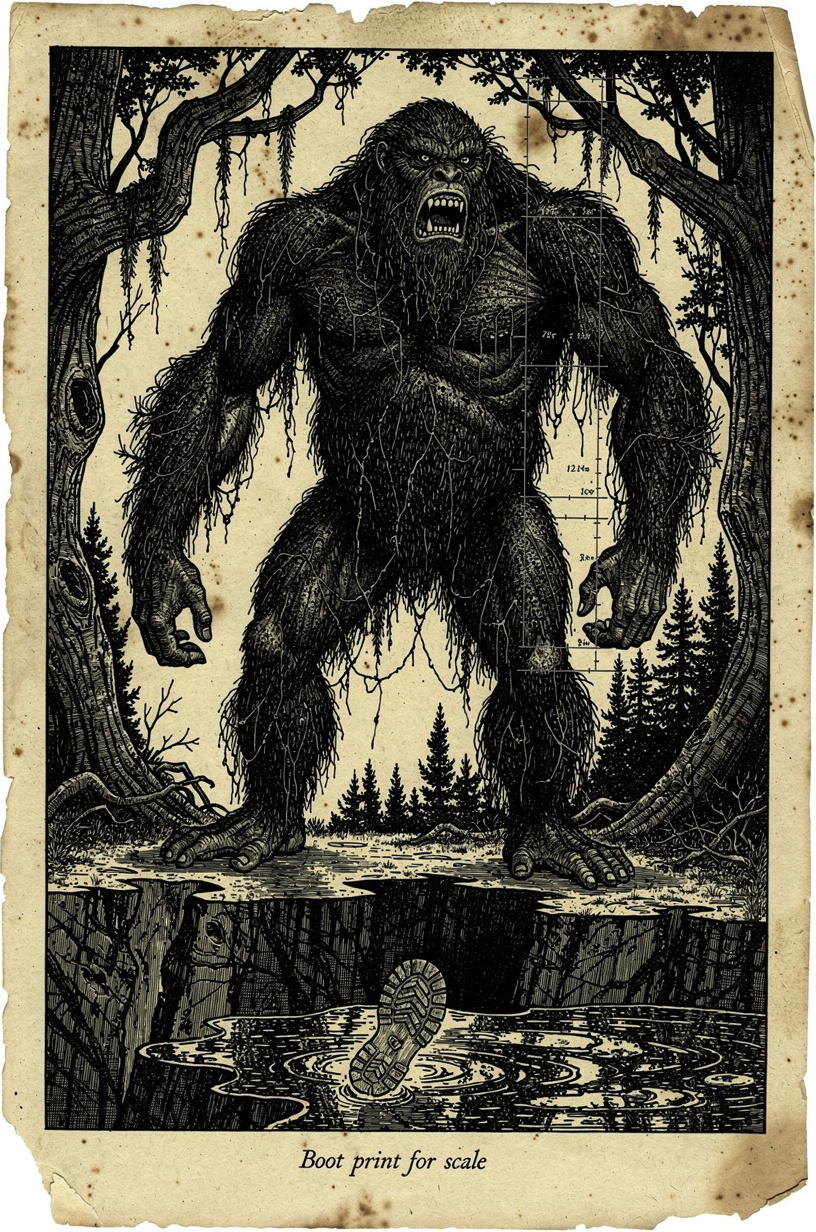
- Mogollon Rim escarpment, AZPrimary zone; highest report density
- Tonto National Forest, AZBelow-rim drainage encounters
- White Mountains, AZWhite Mountain Apache territory
- Oak Creek Canyon, Sedona areaCanyon system reports, ongoing
Thunderbird
A flying predator of impossible wingspan. The photograph that disappeared.
The Thunderbird occupies a unique position in the cryptid record: it is simultaneously one of the oldest documented aerial entities in North America — with petroglyphs and oral traditions spanning dozens of distinct Indigenous cultures across the continent — and the subject of one of the most frustrating documented evidence failures in cryptozoology. In 1890, the Tombstone Epitaph reported that two ranchers near the Huachuca Mountains killed a large flying creature with a wingspan they estimated at 160 feet, and that they photographed the carcass nailed to a barn wall. The photograph was reportedly published and then lost. Multiple researchers over a century have described remembering it clearly. No copy has been located.
The physical profile described across modern accounts — large flying creatures with wingspans ranging from 12 to 30+ feet, sometimes described as leathery or featherless — suggests a living pterosaur. This classification is difficult to accept on paleontological grounds; it is not impossible on evidential grounds. Several accounts from southwestern pilots and military personnel in the 1950s–1970s describe aerial contacts with large flying forms that do not match any classified aircraft or known bird. These reports have not been publicly resolved.
The Southwest is the canonical Thunderbird territory — the entity appears in Hopi, Navajo, Zuni, and Apache traditions under various names, associated with storms, lightning, and predatory power of significant magnitude. It is described not as an animal but as a being. That distinction is worth maintaining.
"The creature was apparently of the pterodactyl family if we may judge by the description of those who saw it. It was flying toward the east and was passing over the road that leads from Huachuca to Tombstone when first discovered. When finally captured, after a long and exciting chase on horseback, it measured 92 feet in length with a wingspan of 160 feet."— Tombstone Epitaph, April 26, 1890; photograph reportedly published and subsequently lost from all known archives
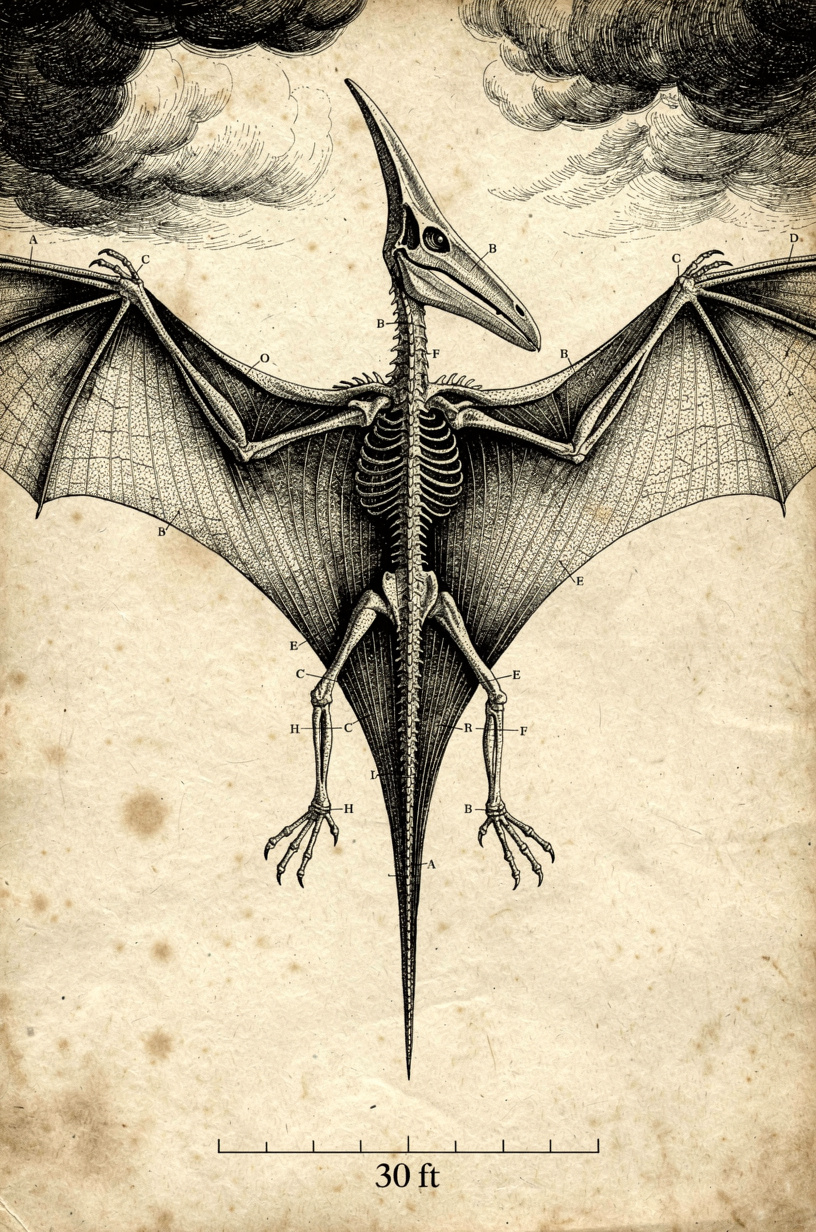
- Huachuca Mountains, AZ1890 Tombstone Epitaph account
- Southeastern ArizonaMultiple 20th-century pilot reports
- Trans-Pecos, TXOngoing accounts, Big Bend region
- Northern New MexicoPuebloan traditional territory
Chupacabra
Livestock killer. Hairless, spined. The eyewitness rate is unusually high.
The Chupacabra presents an unusual documentation challenge: it has a specifically named first sighting (Puerto Rico, 1995, attributed to Madelyne Tolentino), a physical profile that varies significantly between the Caribbean and mainland accounts, and a current distribution across the American Southwest that no single theory adequately explains. The Southwest variant — hairless, heavily built, with a pronounced spinal ridge, long rear legs, and a face described as elongated and canid-adjacent — has been documented in Texas, New Mexico, Arizona, and northern Mexico through two decades of reports that have not been explained by known species.
The defining characteristic in all variants is the livestock killing method: animals — predominantly goats, sheep, and smaller livestock — found with puncture wounds to the neck or throat, completely exsanguinated, with no blood present at the scene. This is not how any known predator kills. Known predators leave blood. They tear. They break bones. The Chupacabra accounts describe a surgical process with no mess and no consumption of flesh — only fluid extraction. The pattern is consistent enough that veterinary pathologists in Texas have documented it without reaching consensus on the cause.
Several Chupacabra carcasses have been recovered in Texas since the early 2000s and subjected to DNA analysis. Results have returned as coyote or coyote hybrid in most cases — but this does not resolve the killing methodology question. A mangy coyote does not drain a goat. The physical carcass identification and the behavioral evidence are not yet reconciled.
"Thirty goats in ten days. Every one of them had the same two holes in the neck, and every one of them was dry. No blood on the ground. No smell. No drag marks. Whatever it is, it isn't eating them — it's taking something else. I've ranched here for forty years. I've lost animals to coyotes, to dogs, to mountain lions. This isn't any of those. This is something different."— Phylis Canion, rancher, Cuero, TX; recovered a carcass she photographed that generated international news coverage; DNA returned as coyote hybrid with mange
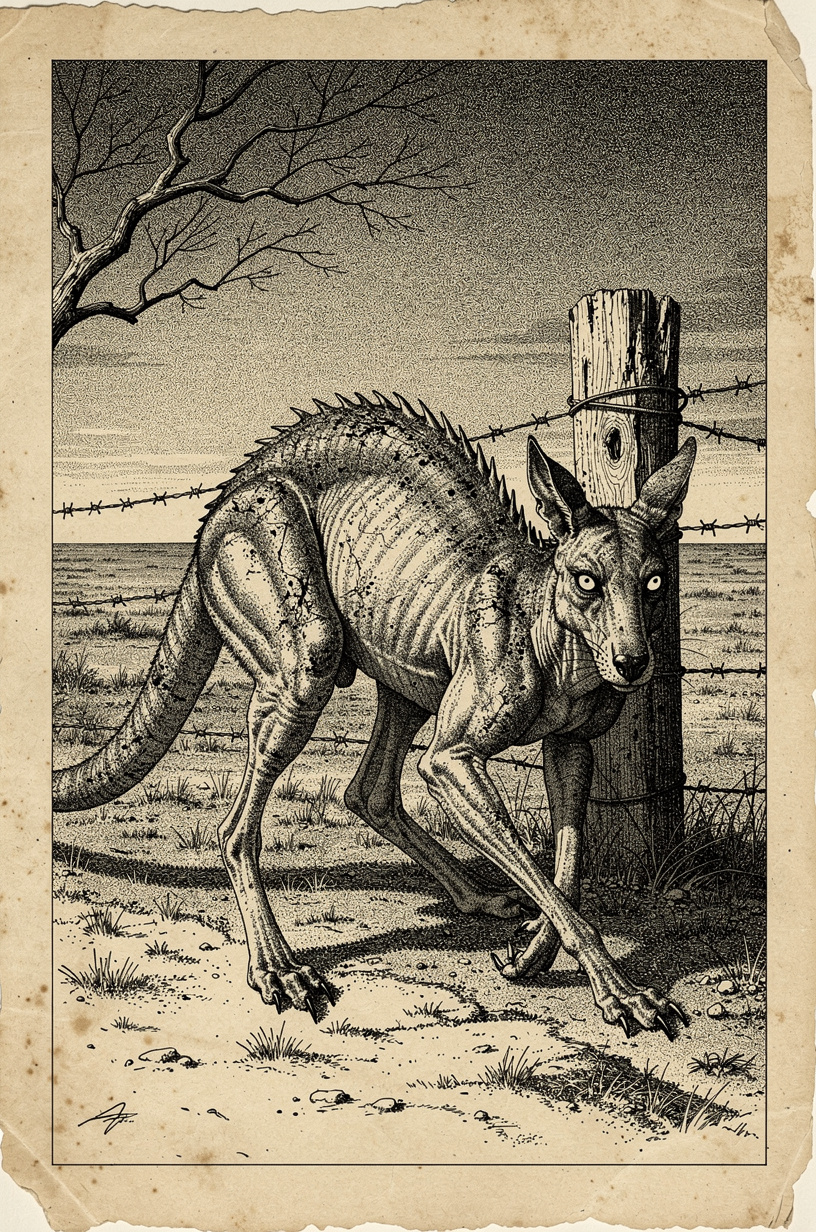
- DeWitt and Victoria Counties, TXHighest documented incident rate
- Sonora desert corridor, AZ/MXCross-border zone; ongoing
- Northern New Mexico rangelandsSmall livestock incidents, active
The White Sands Entity
Reported in the dunes after midnight. No tracks. No shadow. No explanation.
White Sands National Monument — 275 square miles of gypsum dune field in southern New Mexico — sits adjacent to White Sands Missile Range, one of the most heavily restricted military territories in the United States and the site of the Trinity nuclear test in July 1945. The civilian national monument is open to the public. The missile range is not. Between the two, in the zone where civilian access has historically been irregular and oversight is uneven, a class of reports has accumulated that does not fit any conventional category.
The White Sands Entity is described as a luminous form — roughly humanoid in outline, approximately six to seven feet tall, visible against the white dunes at night as a faint phosphorescence rather than a solid figure. The defining features across independent accounts are consistent: it leaves no tracks in the gypsum sand, it casts no shadow in moonlight, and it does not move in a manner consistent with human locomotion — witnesses describe a floating or gliding movement rather than walking. In several accounts, witnesses who observed it from vehicles report that their headlights did not illuminate it in the way they illuminated the surrounding dunes.
The proximity to Trinity Site, to the missile range, and to the geomagnetic anomalies documented in the Tularosa Basin has led researchers to classify this as potentially electromagnetic or energetic rather than biological. This classification is inconclusive. What is documented is a specific entity in a specific restricted geographic zone that has been reported consistently since at least the 1970s, and that leaves no physical evidence of its presence.
"I was on a night shift near the eastern boundary. About 0130 I saw something standing in the dunes maybe two hundred meters out — upright, about my height, glowing faintly. No flashlight, no reflective gear, nothing. I drove toward it and it didn't move. When I got within maybe fifty meters it was just gone. Not fast. Not like it ran. Like a light being switched off. I went to where it was standing. The sand was flat. There were no footprints. There were no marks of any kind."— Filed anonymously via Southwest Anomalous Phenomena Archive; details consistent with three other accounts from the same zone
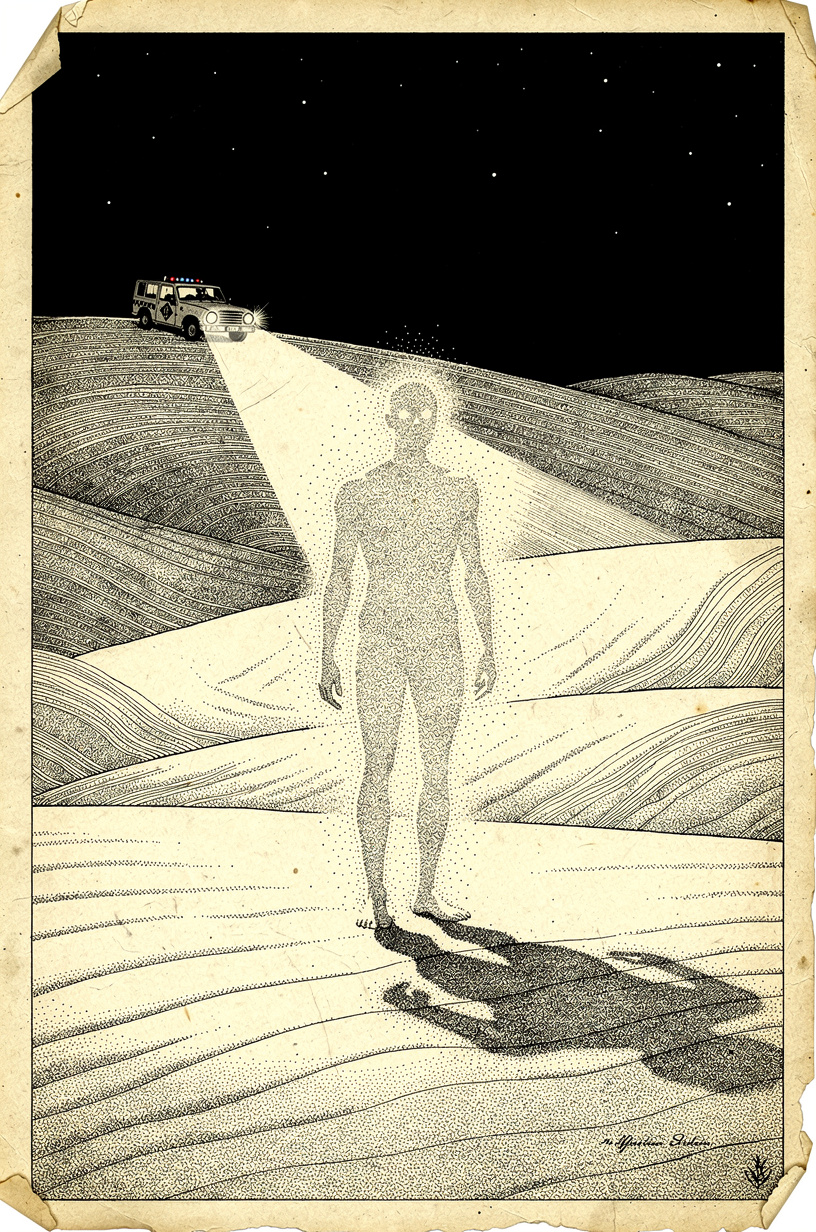
- White Sands NM eastern boundaryPrimary sighting area; near restricted zone
- Tularosa Basin, NMAdjacent geomagnetic anomaly zone
- Trinity Site vicinityGround zero area; access restricted
Yucca Man
Eight feet tall. Reported repeatedly near a Marine Corps installation in the high desert.
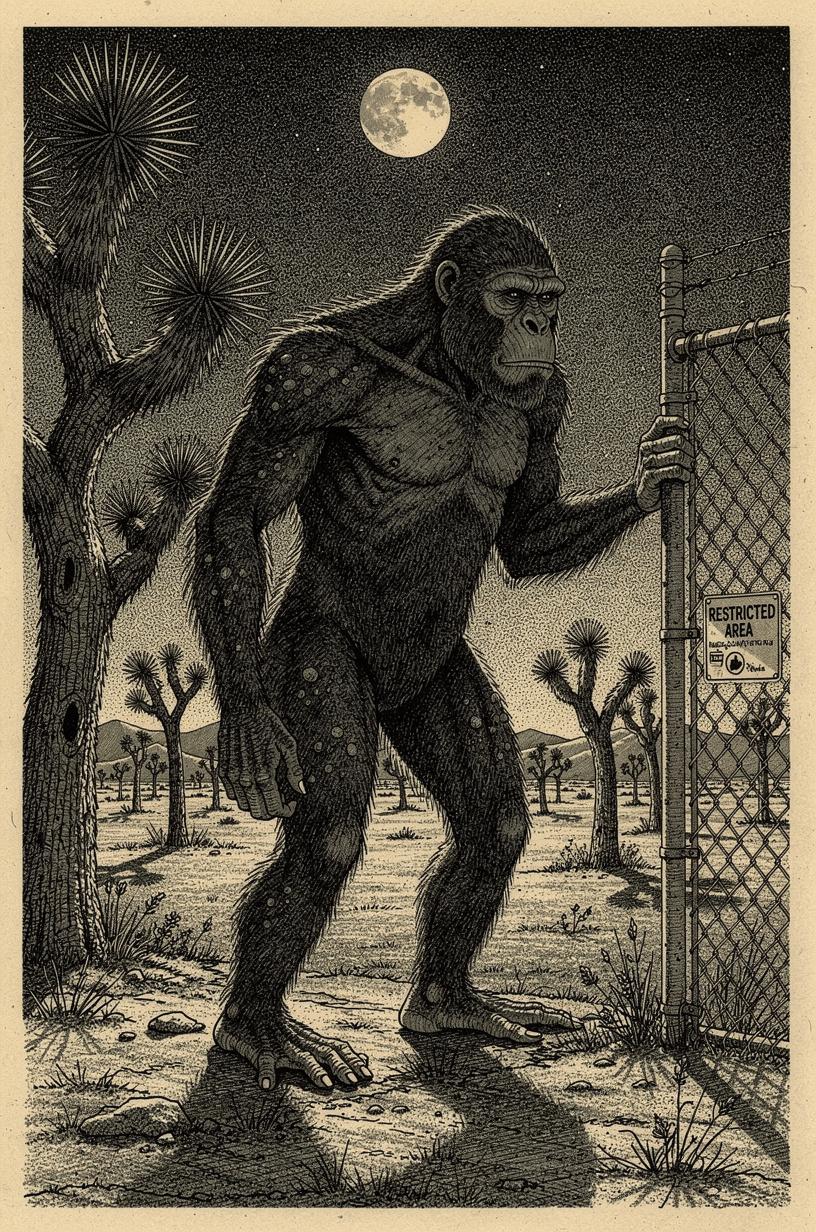
The Yucca Man accounts originate in the high Mojave Desert near Twentynine Palms, California — home to the Marine Corps Air Ground Combat Center, the largest Marine Corps base in the world. The entity has been reported since at least the 1970s, with accounts from both civilian desert communities and, notably, from military personnel who filed internal reports that were not publicly acknowledged. The physical description is consistent: eight feet or taller, covered in dark hair, with a powerfully built frame and a face described as "not quite human, not quite ape" — similar to Bigfoot profiles but behaviorally distinct.
The Yucca Man accounts are unusual because they occur in a desert environment where the ecological conditions for a large primate are not obvious. The high Mojave around Twentynine Palms sits at 2,000–3,000 feet elevation, with Joshua tree forests and significant boulder field terrain that would provide cover for a large entity moving at night. The proximity to the vast military base has led to speculation that some encounters may involve cleared land that pushes entities toward civilian areas, or that base records contain documentation that has not been released.
Several accounts describe the Yucca Man approaching the perimeter fence of the Marine base at night and being repelled by guards. These accounts are not officially confirmed but have circulated among veterans of the base consistently enough to be treated as semi-acknowledged local history rather than rumor. The 29 Palms area has also produced a series of accounts of unusual aerial phenomena that researchers have linked to the Yucca Man zone, though no causal connection has been established.
"I was driving home late on Adobe Road and my headlights caught something crossing ahead of me — maybe thirty feet out. It was standing fully upright. It was taller than my car hood was wide. Dark all over. It turned and looked at me with these eyes that caught the light and then it was gone into the Joshua trees, just gone, and it made no sound when it moved. None at all."— Filed via Joshua Tree area historical accounts archive; corroborated by two independent accounts from same corridor, same decade
- Adobe Road corridor, 29 PalmsPrimary civilian sighting zone
- MCAGCC perimeter, 29 PalmsMilitary-adjacent; unconfirmed reports
- Joshua Tree NP boundaryBoulder field terrain encounters
- Lucerne Valley, high MojaveAdjacent zone, secondary reports
Folkloric & Indigenous Record
Thunderbird — Continental Tradition
No entity in Indigenous North American tradition has a wider geographic distribution than the Thunderbird. It appears in the oral and visual traditions of over fifty distinct peoples, from the Pacific Northwest to the Gulf Coast, from the Great Plains to the Desert Southwest. In Hopi and Pueblo tradition, the Thunderbird is not simply a large bird — it is a being of cosmological significance, associated with storms, with lightning, with the boundaries between human and spirit territory. The Southwest accounts describe something that predates the continent's human memory and continues to be witnessed.
The Anasazi Record
The petroglyphs at Newspaper Rock in southeastern Utah, the canyon wall art throughout the Colorado Plateau, and the kiva imagery of Chaco Canyon and Mesa Verde contain representations of entities that do not correspond to any known animal in the regional fauna — tall bipedal figures, large flying forms, and beings with physical characteristics that align with entities still reported in the same terrain today. Ancestral Pueblo peoples abandoned the Colorado Plateau around 1300 CE. The reasons remain archaeologically debated. The record they left on rock does not resolve the question of what else was sharing that landscape.
Chupacabra Origins
The Chupacabra's documented origin in Puerto Rico in 1995 is itself anomalous — a named, described entity appearing fully formed in the historical record with specific physical characteristics, spreading westward to the American Southwest and Latin America within a decade through independent reports that maintain the core behavioral signature (exsanguination, no blood at scene) while diverging on physical appearance. Whether the Caribbean and mainland variants represent the same species, different species, or something else entirely is unresolved. The killing methodology — the consistent absence of blood — is the thread that connects accounts across thousands of miles.
The Mogollon Rim in White Mountain Apache Tradition
The White Mountain Apache have maintained continuous occupancy of the Mogollon Rim country for centuries. Their oral tradition includes accounts of large, hairy beings associated with specific terrain features along the Rim — canyon systems and drainages that elders identify as places where these entities have always been present. Contemporary Apache hunters from the Fort Apache Reservation continue to report encounters consistent with the historical tradition and with non-Indigenous accounts from the same territory. These are not stories brought in from elsewhere. They are site-specific records of a geographically bounded presence that predates European contact by centuries.
Filed Accounts
"It screamed at me for three minutes from sixty yards. I have never in my life wanted to leave somewhere so badly."
Bowhunter in Tonto National Forest below the Mogollon Rim. Entity screamed repeatedly from progressively closer positions. Witness maintained composure, retreated at walking pace. Returned to same area the following year and found a tree broken eight feet off the ground. Not a break. A twist.
"My grandfather told me not to hunt that drainage. He never told me why. Now I know."
White Mountain Apache hunter in the Fort Apache area describes a multi-generational family avoidance of a specific canyon drainage, handed down as instruction without explanation. On his first solo hunt in the area, he encountered a massive bipedal figure at the canyon rim. He left and has not returned. He asked his grandmother about it afterward. She already knew which canyon.
"Thirty goats in ten days. Two holes in the neck. Not one drop of blood anywhere."
Texas rancher Phylis Canion documents a systematic livestock killing event in Cuero, TX that generated national coverage. Recovered a carcass — hairless, spined, distinctly non-coyote in several features — that DNA analysis returned as coyote hybrid. The killing methodology remained unexplained. A mangy coyote does not drain a goat dry.
"It was at the fence line two nights running. The third night it was gone. We didn't file a report."
Former USMC corporal stationed at Twentynine Palms submits account describing a large bipedal figure at the installation perimeter on consecutive nights, observed by himself and another guard. Both agreed independently on height (over eight feet), fur, and the fact that it did not respond to flashlights the way a human would. Neither filed an official report. Neither returned to night perimeter duty voluntarily.
"It was standing in the dunes and it was glowing. Not bright — like something behind frosted glass."
Civilian at the eastern boundary of White Sands National Monument observes a faintly luminous form on the dune face at approximately 0200. Drives toward it. Form remains stationary. At fifty meters, it ceases to be visible between one moment and the next. Sand at the location shows no tracks, no indentations, no sign of any presence.
"The wingspan put it at thirty feet minimum. It was not a California Condor. I know what those look like."
Wildlife photographer in the Big Bend region of Trans-Pecos Texas reports a large flying form soaring over a canyon rim at approximately 400 feet elevation. Photographed it. The photographs show a dark form but do not resolve feathers, skin, or wingspan definitively. The photographer had extensive experience with California Condors and is clear that this was not one. No photograph has been published at the photographer's request.
Open Desert Encounters
The desert affords more visibility than forest environments, which means entities can be observed at greater distance. If you see something bipedal on open ground that does not resolve into a human being as you close distance, stop closing distance. Note the location precisely — GPS coordinates, landmark triangulation. The desert floor holds tracks well. Approach the area only in daylight and document whatever physical trace remains.
Livestock Incident Protocol
If you discover livestock with unexplained injuries matching the Chupacabra profile — puncture wounds to the neck, complete absence of blood at the scene, no visible tracks — photograph before disturbing the carcass, note the time and weather, and file with your county livestock authority and with the appropriate cryptid research organization. Tissue samples from the wound margin have the highest diagnostic value. Do not assume predator attack without accounting for the blood absence.
Restricted Zone Boundaries
Do not enter White Sands Missile Range or MCAGCC restricted zones under any circumstances. These areas are actively monitored, and civilian violation carries serious federal consequences. The entities reported in proximity to these installations can be observed from legal boundary positions. Several of the most credible White Sands Entity accounts were filed by people who did not trespass. Maintain the boundary. The boundary is there for multiple reasons.